

Off Book in Three Days: Line Memorization Techniques for Actors
The fastest reliable way to learn lines is active recall in small chunks, practised with spaced repetition and anchored by movement or cue recordings. Skip passive re-reading. Pick one short scene now, read it once for context, then cover the page and test yourself. That single pass, followed by sleep and one pressure test tomorrow, is what makes the words stick.
TL;DR:
Active recall combined with small chunking of three to five lines significantly improves memorization compared to passive re-reading.
Movement and physical blocking, such as walking the text along with the script, deeply reinforce line recall by linking words to physical cues.
Recording cue lines and listening to them during downtime helps build recognition but must be paired with active recall for long-term retention.
Using first-letter prompts and blackout tests are effective as verification tools when recalling scenes, especially late-stage learning.
A structured three-day emergency plan focusing on scene logic, targeted drilling, and pressure testing reliably allows memorization of limited scenes under tight deadlines.
Table of Contents
What are the best line memorization techniques to try right now?
If you only take one thing from this article, take this: testing yourself beats reading the page again, every single time. Here’s the toolkit we recommend at Ocean Theatre, in the order most performers find useful.
Active recall (cover and recall): read a line, cover it, say it aloud, then check.
Chunking: break the scene into groups of 3 to 5 lines and master each before moving on.
Partner runs: get someone to read the other role while you respond from memory.
Walking the text: move a step at every comma, change direction at every full stop.
Cue recordings: record the other character’s lines and reply into the gaps.
First-letter tests: write the initial letter of each word as a late-stage prompt sheet.
Spaced repetition: review at increasing intervals rather than cramming once.
Three-day emergency plan: build logic, drill weak points, then pressure-test.
Each one solves a different problem, which is exactly why combining them works better than relying on any single method.
Chunking and active recall: how to structure practice sessions
Seasoned performers rarely memorise line by line. They map the thought-chain of a scene, the logical sequence of ideas that carries one line into the next, so the dialogue follows a story rather than a list of syllables, according to how actors remember their lines. That’s why chunking works: it forces you to learn meaning in manageable blocks instead of raw text in one long stream.
Pick chunks of 3 to 5 lines for stage work, or roughly 100 words if you’re learning to camera. Build forward, only adding a new chunk once the previous one is solid.
Read the chunk aloud twice, focusing on what the character wants.
Cover the page and recall it from memory.
Check against the script and note exactly where you dropped words.
Repeat the cycle, then link the chunk to the one before it.
A 20 minute session covering four chunks this way beats an hour of silent reading. Passive re-reading creates a false sense of familiarity, while active recall, the method behind the well-documented testing effect, drives retention that actually survives under pressure, as Teleprompter Works explains.
Pro Tip: Say the line in your own words first, then say it as scripted. If you can’t paraphrase it, you don’t understand it yet, and understanding is what makes recall stick.
Movement, blocking and ‘walking the text’
Words attached to physical action are far easier to retrieve than words sitting still on a page. That’s the logic behind walking the text, and it’s a technique practitioner guides return to again and again, as Dramatics’ guide to memorising lines notes.
Move one step forward at every comma, and change direction at every full stop.
Once the pattern feels natural, rehearse in the real performance space so the blocking itself becomes a memory cue.
Keep the movement loose rather than fixed. It’s a learning tool, not a final staging choice, so don’t let it lock in delivery decisions too early.
Anchoring punctuation and phrasing to physical movement makes the line feel embodied rather than recited, which is exactly the effect you want by opening night.
Auditory methods: recording cue lines and listening back
Recording your scene partner’s lines turns any spare moment into a rehearsal. Voice memo apps make this simple.
Record the other character’s dialogue only, leaving a gap for your response.
Label each file by scene and page number so you can find it fast.
Play it back during low-attention tasks: commuting, walking the dog, washing up.
Schedule short, frequent listens rather than one long session.
Audio builds recognition quickly, but it needs pairing with active recall to properly stick. Listen once passively, then listen again and actually answer out loud before checking yourself against the script.
Mnemonic and verification tools: first-letter sheets and blackout tests
First-letter sheets, where you write just the initial letter of each word, work best as a verification step once you already roughly know the scene. They test recall without handing you the answer, which is exactly what makes them useful late in the process rather than early, according to HitCue’s breakdown of the first-letter method.
Write initials for a chunk you’ve already drilled with active recall.
Say the full line from the initials alone; only glance at the script if you’re stuck.
For backstage nerves, try a blackout test: no prompts at all, just the cue line spoken aloud by someone else.
Pro Tip: If you find yourself needing the initials sheet every time, you haven’t learned the line yet. You’ve learned the prompt.
Spaced repetition, sleep consolidation and practice scheduling
Cramming a scene the night before rarely holds up under stage lights. A spaced schedule does.
Review immediately after first learning a chunk.
Review again an hour later.
Do a final pass before bed, no new material, just consolidation.
Review again the next morning.
Space further reviews 2 to 3 days apart as the scene solidifies.
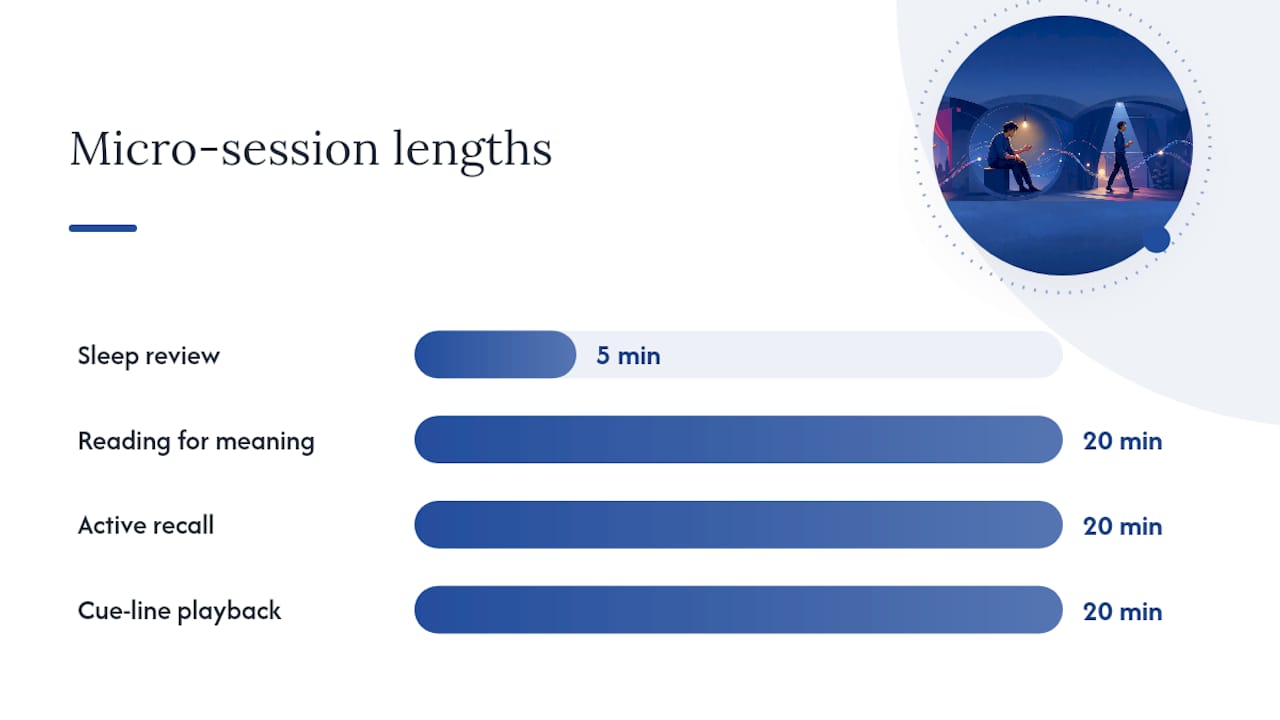
A short review before sleep genuinely helps. Sleep-based consolidation strengthens verbal memory, so a five-minute pass through the day’s chunks right before bed yields stronger retention than the same five minutes spent earlier in the day, per Teleprompter Works. For a quick top-up between rehearsals, try a 20 20 20 mini-session: 20 minutes reading for meaning, 20 minutes active recall, 20 minutes cue-line playback.
For long scripts or precise camera dialogue where a single dropped word matters enormously, lean on a teleprompter rather than pure memory. Otherwise, memorisation gives a far more natural performance.
Emergency three-day off-book plan
Run out of time? A structured three-day sprint, tested by working performers, reliably gets limited scenes off-book when followed in strict order, according to HitCue’s emergency off-book plan.
Day one: understand the scene’s logic first. Build thought-chains and mark emotional beats. Skip heavy repetition entirely.
Day two: drill your specific drop points using cover-and-recall. Record cue lines and keep a running log of exactly where you fail.
Day three: pressure-test with a cold run, no stopping. Return only to the drop points from your log for targeted drilling.
Understanding the scene’s logic before drilling problem lines is what makes this compressed timeline actually work, rather than just producing a shakier version of normal rehearsal.
Practical partner runs and rehearsal etiquette
Set ground rules before you start: your partner cues you, never gives you the line, and calls out only where you actually go wrong. Vague feedback wastes both your time.
Agree the rules upfront: cueing only, no line-feeding, focused drills on weak spots.
Ask directors for objective checks (did you hit the right cue, the right beat) rather than general impressions.
Timebox runs to 10 or 15 minutes and prioritise your known drop points, not the whole scene every time.
Troubleshooting: why lines fail and quick backstage fixes
Not every dropped line has the same cause. Test whether it’s recognition or recall: if you know the line when you hear the cue but can’t produce it alone, that’s a recall gap, not a knowledge gap.
Cover test (script hidden) checks recall; cue test (partner reads the cue) checks recognition.
Backstage, use micro-chunks, breathe and resume, or a whispered cue-line prompt rather than freezing.
If a full gap looms, adjust delivery and paraphrase the idea rather than stopping the scene dead.
A note from the rehearsal room
We build every one of these methods into how we rehearse at Ocean Theatre Company, because a nervous fourteen-year-old backstage needs a system that actually holds, not just good intentions. Our approach to focused rehearsal, detailed in our guidance on succeeding in the programme, pairs active recall with genuine stage time. If you’re just starting out, pick one method here and practise it on one short scene today. Everything else follows from that first honest attempt.
For young performers who want that structure built in from day one, The Company (14 to 19) runs weekly rehearsals under professional direction, with two full productions a year to put these techniques into practice under real stage lights. You can see what that looks like on stage in our current production, Crazy For You, or browse Ocean Merchandise to bring a bit of Ocean spirit home.
What people are getting wrong about learning lines
Most beginners treat memorisation as a memory problem. It’s actually a comprehension problem wearing a memory costume. Every technique in this article, chunking, walking the text, cue recordings, works because it forces understanding before it demands recall. Skip that step and you’re left gluing words together with brute repetition, which collapses the moment nerves hit.
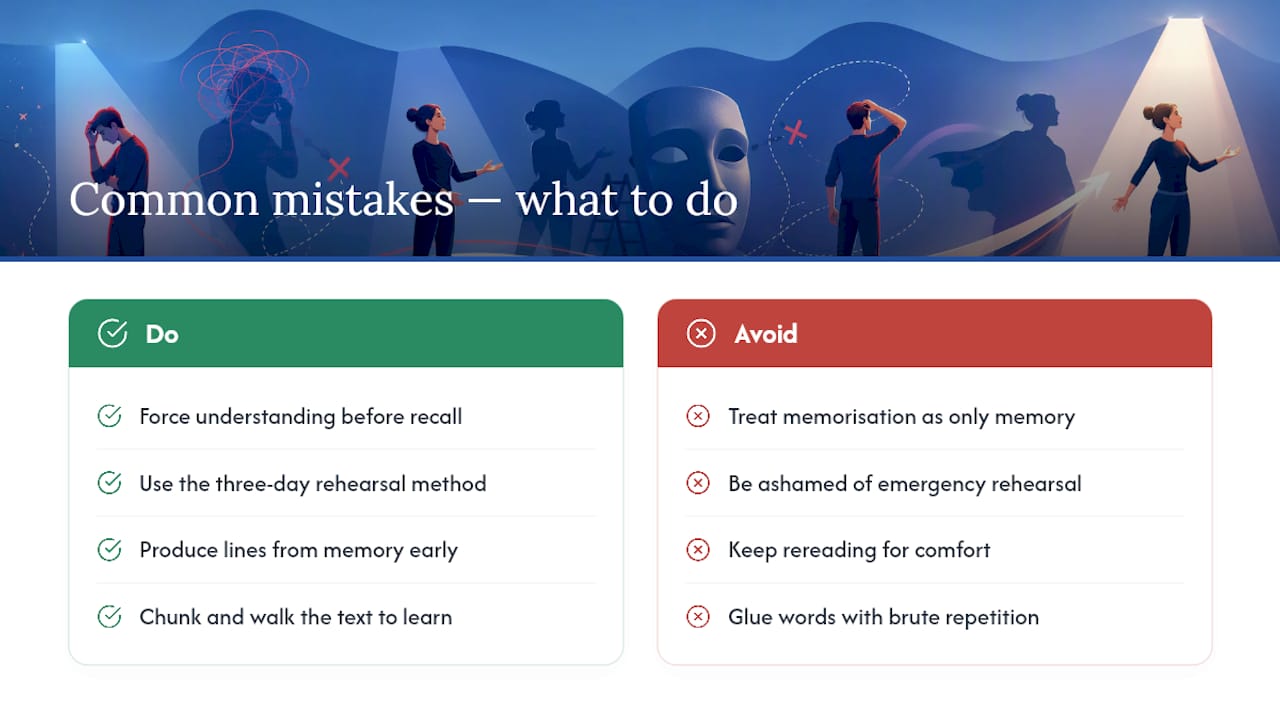
The other mistake is treating the three-day emergency plan as a last resort to be ashamed of. It isn’t. It’s a genuinely good rehearsal method compressed into a tight window, and plenty of working performers use a version of it even when they have weeks to spare, because Day 1’s focus on logic before drilling is simply sound practice. Slow rehearsal and emergency rehearsal aren’t different skills. They’re the same skill at different speeds.
What I’d push back on hardest is the instinct to keep re-reading a script “one more time” for comfort. It feels productive. It isn’t. Every study on the testing effect points the same direction: producing the line from memory, even badly at first, builds a stronger trace than reading it perfectly for the tenth time.
— Andrew
Sources
FAQ
How do you memorize lines quickly?
Use active recall in small chunks of 3 to 5 lines, testing yourself by covering the page rather than re-reading. Combine this with spaced review over a few days and a short pass before sleep for stronger retention, as Teleprompter Works explains.
What is the 7 3 2 1 method of memorization?
This isn’t a standard technique in actor training guides, and definitions vary widely online. Rather than chase an unverified formula, use the spaced schedule covered above: immediate review, an hour later, before bed, next morning, then every 2 to 3 days.
How do actors memorize lines so quickly?
Experienced performers map the thought-chain of a scene, learning why each line follows the last rather than memorising words in isolation, according to MIT Press’s Reader. That logic, paired with chunking and active recall, is what makes fast memorisation possible.
How do child actors memorize lines?
Younger performers benefit from the same core methods, chunking, cover-and-recall, and walking the text, but usually need more frequent, shorter sessions and hands-on partner runs. At Ocean Theatre, professional-led rehearsal within The Company (14 to 19) builds this practice into weekly sessions rather than leaving it to solo study.
Recommended
Comments